Asia-Pacific Aerospace Science &
Engineering Conference.
Join leading researchers and practitioners in exploring the frontiers of physics and engineering.
Call for Papers→
Harbin, China
Organized By



Co-Organize By



About the
Conference
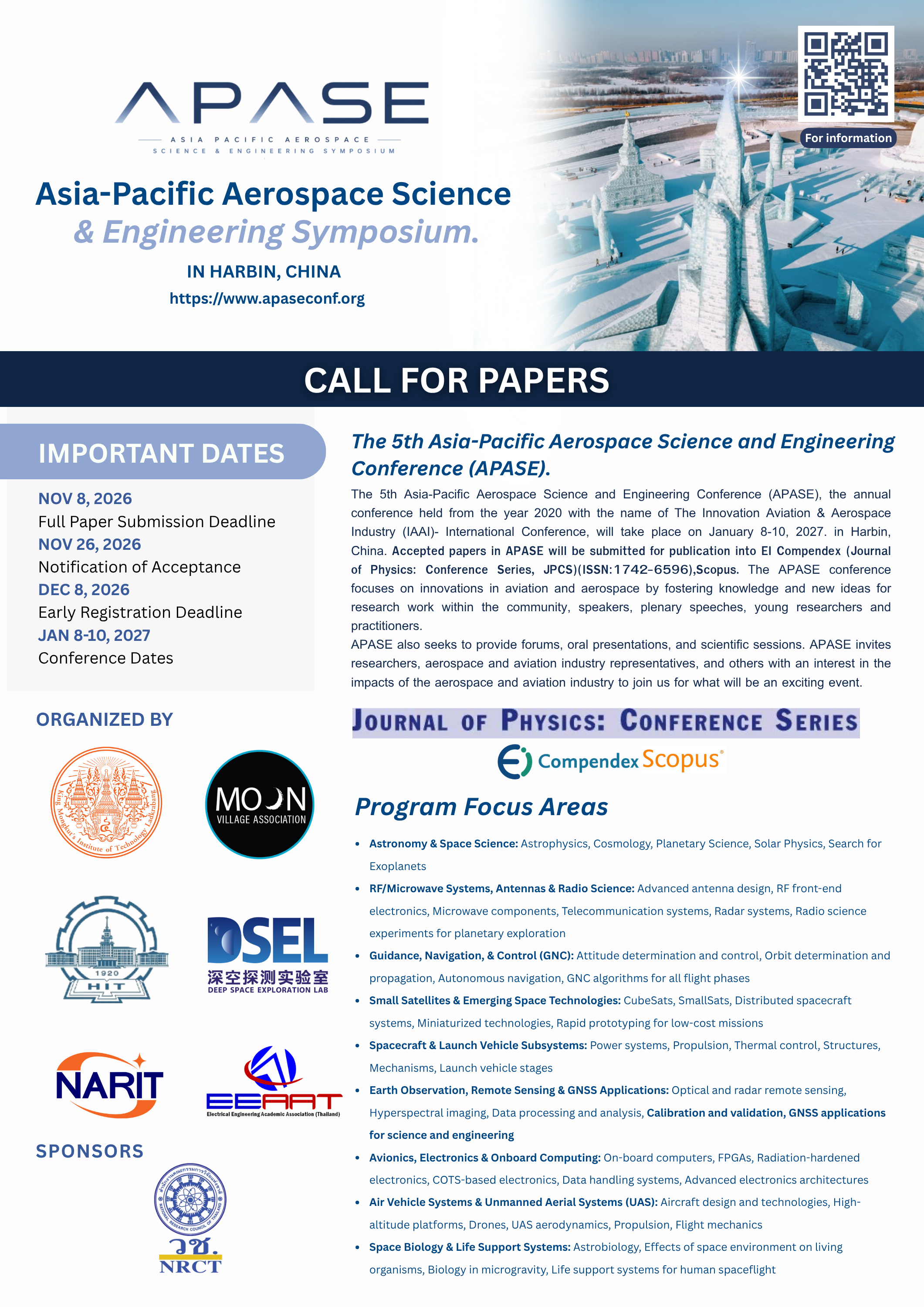
The 5th Asia-Pacific Aerospace Science and Engineering Conference (APASE).
The 5th Asia-Pacific Aerospace Science and Engineering Conference (APASE), the annual conference held from the year 2020 with the name of The Innovation Aviation & Aerospace Industry (IAAI)- International Conference, will take place on January 8-10, 2027. in Harbin, China. Accepted papers in APASE will be submitted for publication into EI Compendex (Journal of Physics: Conference Series, JPCS)(ISSN:1742-6596). The APASE conference focuses on innovations in aviation and aerospace by fostering knowledge and new ideas for research work within the community, speakers, plenary speeches, young researchers and practitioners.
APASE also seeks to provide forums, oral presentations, and scientific sessions. APASE invites researchers, aerospace and aviation industry representatives, and others with an interest in the impacts of the aerospace and aviation industry to join us for what will be an exciting event.



Important Dates
Stay informed about critical deadlines. Early bird registrations offer exclusive networking sessions and lowered fees.
 View Call for Papers
NOV 8
2026
Paper Submission Deadline
Deadline for full paper submission
NOV 26
2026
Notification of Acceptance
Deadline to notify authors of acceptance results
DEC 8
2026
Early Registration Deadline
Deadline for early registration
JAN 8–10
2027
Conference Dates
APASE conference in Harbin, China
Program Focus Areas
Technical Research Tracks
A broad set of aerospace and space science tracks covering mission systems, technologies, operations, and future workforce growth.
- Astronomy & Space Science: Astrophysics, Cosmology, Planetary Science, Solar Physics, Search for Exoplanets
- RF/Microwave Systems, Antennas & Radio Science: Advanced antenna design, RF front-end electronics, Microwave components, Telecommunication systems, Radar systems, Radio science experiments for planetary exploration
- Guidance, Navigation, & Control (GNC): Attitude determination and control, Orbit determination and propagation, Autonomous navigation, GNC algorithms for all flight phases
- Small Satellites & Emerging Space Technologies: CubeSats, SmallSats, Distributed spacecraft systems, Miniaturized technologies, Rapid prototyping for low-cost missions
- Spacecraft & Launch Vehicle Subsystems: Power systems, Propulsion, Thermal control, Structures, Mechanisms, Launch vehicle stages
- Earth Observation, Remote Sensing & GNSS Applications: Optical and radar remote sensing, Hyperspectral imaging, Data processing and analysis, Calibration and validation, GNSS applications for science and engineering
- Avionics, Electronics & Onboard Computing: On-board computers, FPGAs, Radiation-hardened electronics, COTS-based electronics, Data handling systems, Advanced electronics architectures
- Air Vehicle Systems & Unmanned Aerial Systems (UAS): Aircraft design and technologies, High-altitude platforms, Drones, UAS aerodynamics, Propulsion, Flight mechanics
- Space Biology & Life Support Systems: Astrobiology, Effects of space environment on living organisms, Biology in microgravity, Life support systems for human spaceflight
Publication & Proceedings
The 5th Asia-Pacific Aerospace Science and Engineering Conference
The 4th Innovation Aviation & Aerospace Industry - International Conference
The 3rd Innovation Aviation & Aerospace Industry - International Conference
Innovation Aviation & Aerospace Industry - International Conference
Innovation Aviation & Aerospace Industry - International Conference
Institutional Support
Sponsors